Aidan Singh
Part 1: Breadboards
In our first class, we began creating circuits with breadboards. Breadboards are a way to make circuit design more easy and efficient. It creates the opportunity to have several connections without worrying about shorting the circuit, and for multiple things to be connected to each other.
It is organized in rows and columns. The left and right sides of the board are separate systems (nothing between them is connected). The sides contain columns that run the length of the board, which are designed to be used as a voltage source and ground (positive and negative sides of a battery connection). Each port in these individual columns is connected. The remaining spaces between the columns are organized in rows, where every space in a row is connected (5 across, not through the center of the board). Each of the 5 ports across are connected.
Part 2: My first Circuits
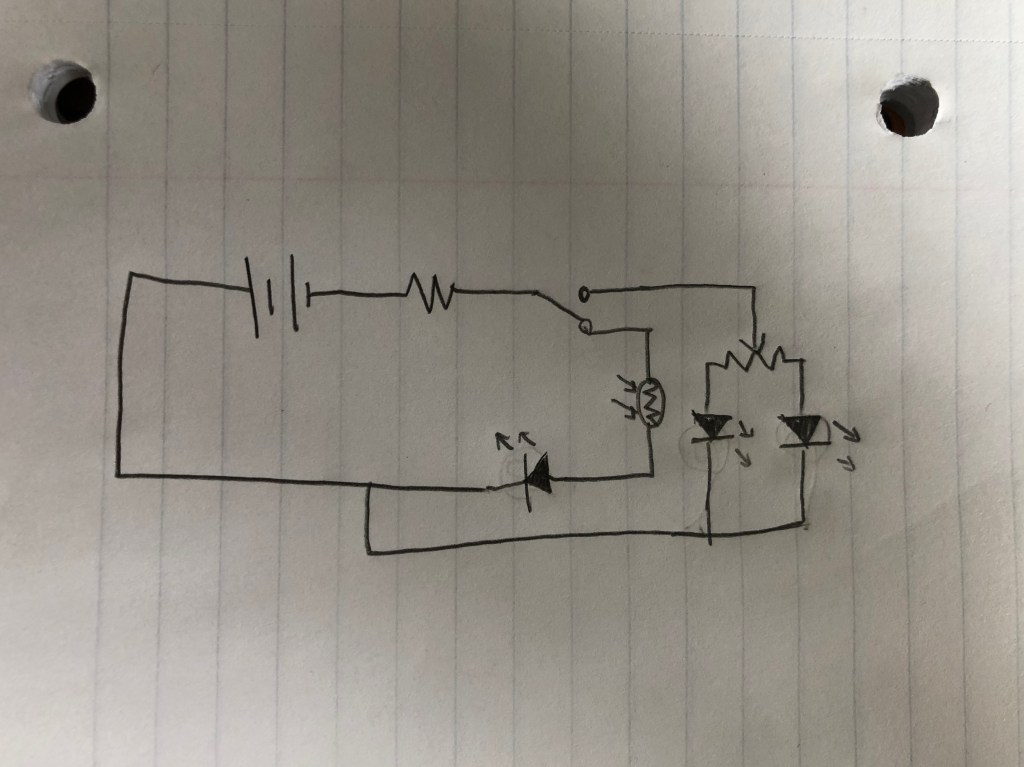
Part 3: Multimeters
Multimeters are tools that have a multiplicity of functions; They can tell the resistance of an object, measure the voltage between two points, and test the connectivity between two points, for example. One use is measuring the voltage in a battery. If a circuit isn’t working, you can use the connectivity function to see if everything is wired properly.
Analog Circuit Troubleshooting Notes
When trying to adapt my circuit from class to the new homework one, I was limited on space. I had to spread out my components and wires in order to make it compatible with the new editions.
Notes on Previous Final Projects
Connor Riley’s final project was inspiring in that he was able to put multiple effects into one circuit. It made me think of how using this effects could be useful in a live/performance setting, or how the different effects could be used together.
Jaye Sosa’s project was a polyphonic synth with three buttons, playing thirds. This project was inspiring because she used it to make a song and uploaded it onto soundcloud. The constraints of how the instrument could be used made the song very interesting. Also her schematic seemed relatively simple.
Jason Wallach’s project involved using synthesizers he owns to control components of itself and other synths. This was eye opening because I hadn’t thought of combining different pre-existing circuits with one I build. His descriptions and schematic explanations were extremely thorough too.
 Aidan Singh's Electronics updates